You may or may not have heard of this phrase (or maybe something similar), perhaps in your precalculus class: a swing through theta. What kind of image does it bring to your mind? A rotation on a coordinate plane? A rotation on a complex plane? Maybe a little paper theta attached to a string that you give a little swing? Well, I happened to take this phrase quite literally.
But before I get into what exactly I concocted, let’s discuss what this phrase might actually mean. I started associating this phrase with rotation on the complex plane using the notation cis (θ). This notation is basically an abbreviation of cos (θ) + i sin (θ). By using cis (θ), you can find the value of the complex number you land on by rotating by θ radians. If you’re already confused, let me start from the beginning. If you’re good with this topic and don’t feel like relearning it (I mean you’re still free to enjoy mathematical paradise by reading it, why not), Ctrl + C and Ctrl + F the following phrase: “Now, here’s what I did” (you’re welcome).
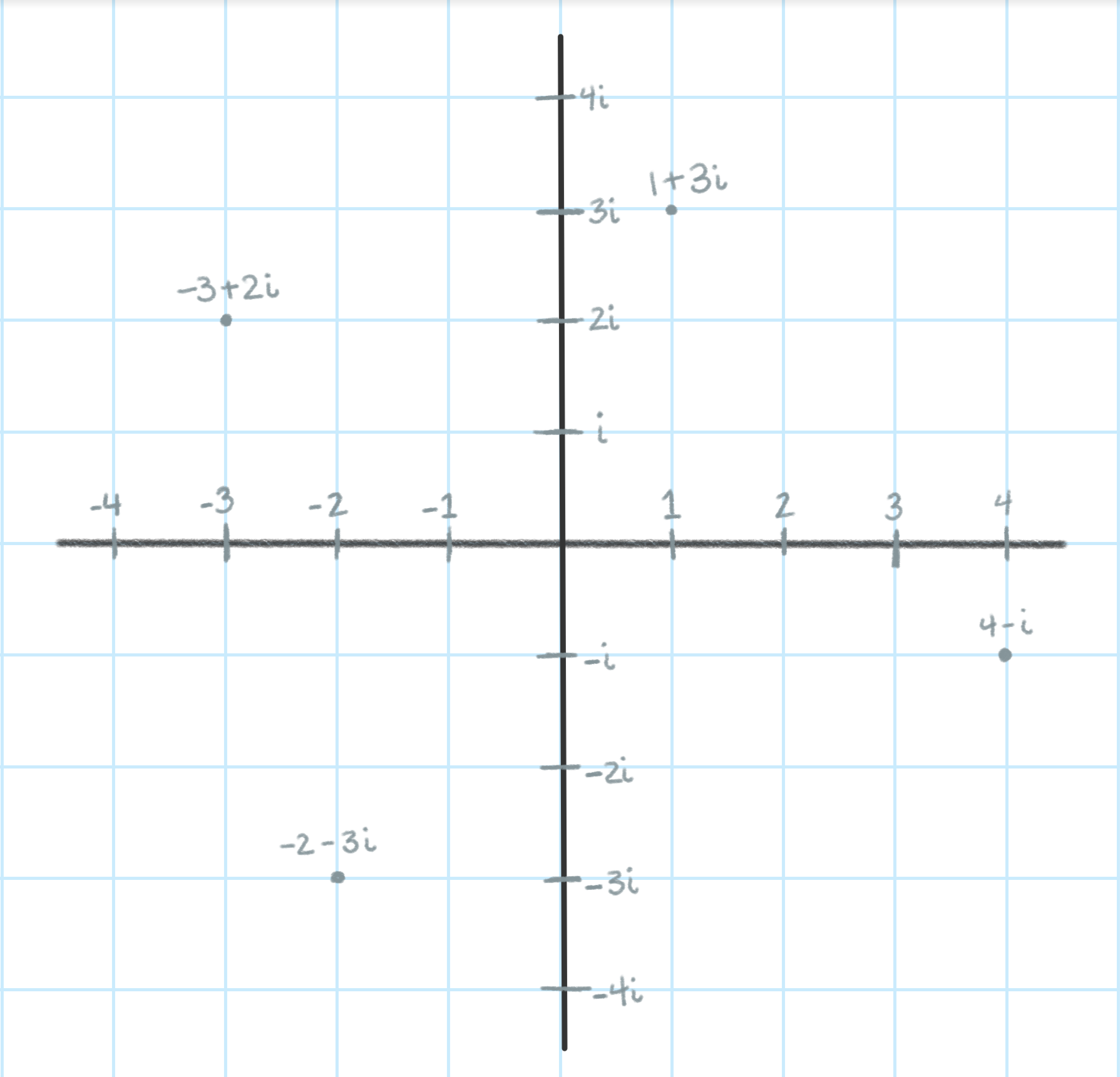
The number i is equal to sqrt(-1). If you know that squaring any real number always yields a positive number, then you must know that i cannot be a real number. As a result, we have to create a whole other set of numbers called imaginary numbers (kind of like imaginary friends, but doesn’t necessarily involve talking to yourself). All multiples of i fall into the category of imaginary numbers. Now, it doesn’t end here. What if you combine real numbers with imaginary numbers? If you add a real number to an imaginary number, you get what is called a complex number (and you thought the quadratic formula was complex). These complex numbers are represented on the complex plane (duh). Here’s how it works:
The horizontal axis, what would be the x-axis in the Cartesian plane, is now the real number line. The vertical axis, what would be the y-axis in the Cartesian plane, is now the imaginary number line. Suppose you have a complex number a + bi. This means you travel distance a along the real number line and distance b along the imaginary number line, and the coordinate point (a, b) represents the addition of a and bi.
This can be taken a step further by including trigonometry. Remember when you thought sine and cosine could only appear in a triangle and then your precalculus teacher drew a unit circle and said that each point on the circle can be represented by the sin and cos of the angle rotated? Yeah, we’re going to do that again. When you rotate by θ in the unit circle, the x-coordinate represents cos (θ) and the y-coordinate represents sin (θ). Assuming that our radius is still 1, when you rotate by θ in the complex plane, a represents cos (θ) and b represents sin (θ). The expression bi is a multiple of i and its coefficient happens to be sin (θ) in this case. (Even though we are multiplying a real number and an imaginary number, the product is still considered imaginary.) So this is how we get cos (θ) + i sin (θ) or cis (θ).
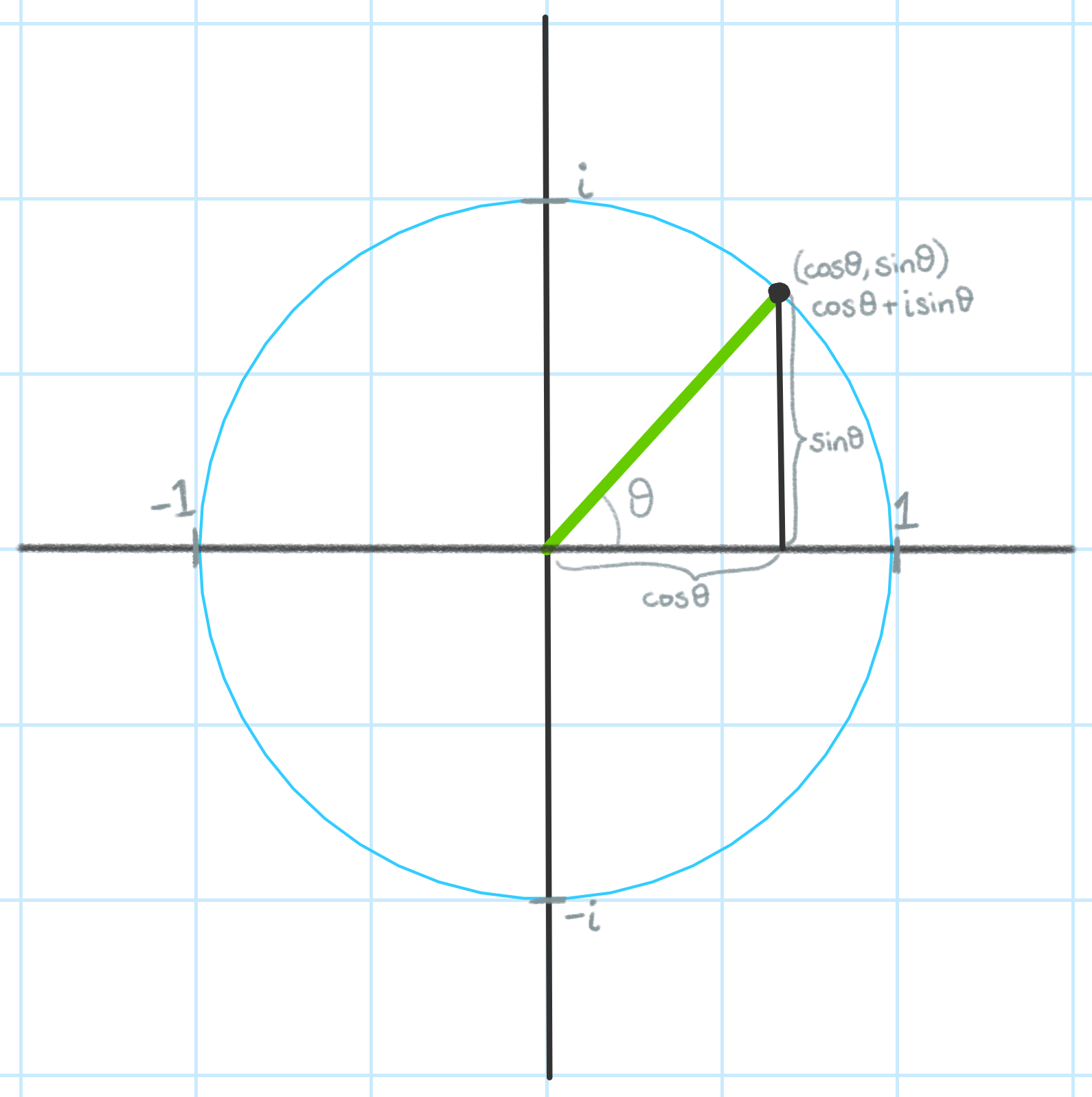
What’s super neat about this notation is that it has two very simple properties. Suppose I have two complex numbers a cis ( α ) and b cis ( β ), where a and b are the magnitude (length of radius/distance from origin) of the complex number, and α and β are the angles rotated to get to each respective complex number. When we multiply these complex numbers, two cool things happen. The magnitudes a and b get multiplied and the angles α and β get added (this all can be proven using Taylor Series… I’ll probably get to that in another post). By multiplying a complex number, you can perform a scaling and a rotation! So many concepts are already coming together! (Isn’t this great :D)
Maybe now the connection between my phrase and this concept is a little clearer. By multiplying by cis (θ), we experience a swing through theta!
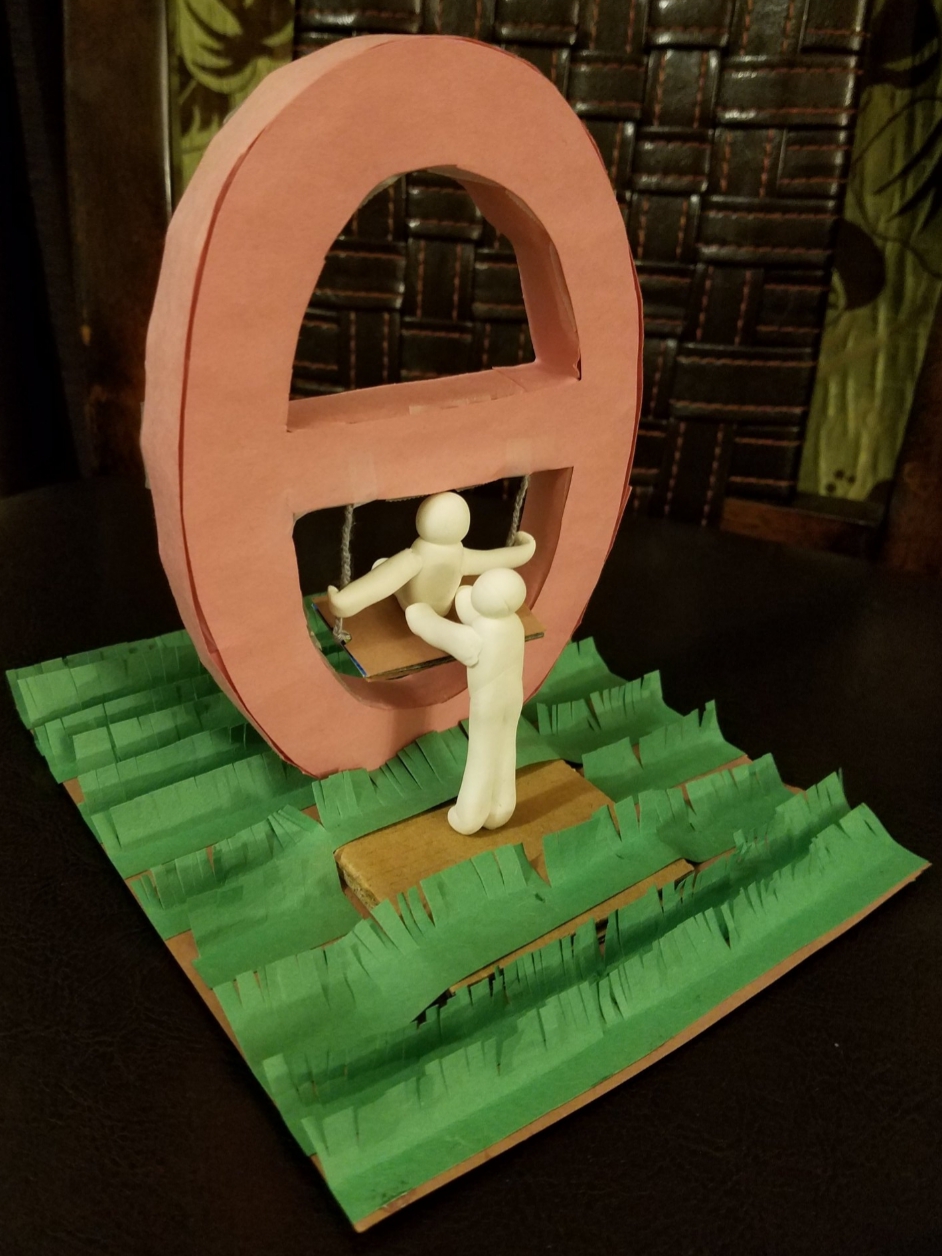
Now, here’s what I did. It was my friend’s birthday, and she’s a little bit of a nerd like I am (which is a good thing, obviously). I was pretty confident that she would enjoy my play on words and mathematical concepts, and I will gladly say that she was not disappointed (other than the fact that I put her gift in a box that was originally meant for trash bags). I made a sculpture of the symbol θ. It was about as big as a small laptop screen. Hanging from the bar in the middle of the θ was a little swing. With modeling clay, I made a tiny person and set it upon the seat of the swing. Behind the swing was another tiny person giving his/her friend a push. It not only represented a close relationship between friends but also launch into the magical realm of mathematics. At last, in front of me was the literal swing through theta! Here’s what it looked like:
Now that you’ve had such a wonderful time reading this post, I want to end it with a couple of words. First of all, feel free to use this idea (or make it better)! Make one for yourself, for a friend, for your precalculus teacher; it is sure to put a smile on at least one of them. I really hope you found this post interesting and maybe you learned something. This is my first ever math-related post, so that’s very exciting for me. I’ll be posting more and I’ll be improving as well. I hope you’ll look forward to it. Have a good day and stay mathemagical!
 Sensorium
Loved my present by the way!! One of the best ones I’ve ever gotten!!
LikeLiked by 1 person
[…] of counting. Similarly, apples are units of counting. If you read my post about complex numbers (click here), you learned about the imaginary number line and how it works sort of like the real number line. […]
LikeLike
The multiplication of complex numbers leading to scaling and rotation can also be proven using trig identities, but using e raised to iθ (via Taylor series) is surely way neater!
https://www.goodreads.com/book/show/654337.Dr_Euler_s_Fabulous_Formula
LikeLike